Presidential favorites, vintage American recipes and easy Labor Day classics — from George Washington’s hoecakes and Abraham Lincoln’s corn dodgers to LBJ’s barbecue, President Reagan’s macaroni and cheese and Betty Ford’s caramel peaches.
There’s something about Labor Day that feels especially American.
Maybe it’s the backyard barbecue. Maybe it’s the picnic tables covered with dishes everyone brought from home. Maybe it’s the potato salad somebody has made the same way for 40 years, the pan of baked beans that disappears before everything else, or the dessert that immediately makes someone say, “My grandma used to make that.”
And as America celebrates its 250th anniversary, it seems like the perfect time to look back at some of the foods that have been part of the American table for generations.
Because American history isn’t only found in museums and history books. Sometimes, it’s sitting right there on the dinner table.
Presidents and first ladies had favorite breakfasts, comfort foods, family recipes and desserts just like everybody else. Some were surprisingly simple. Others reflected where they grew up, the era they lived in or changing American tastes.
And while the White House has hosted some of the most elaborate dinners in the world, behind all of that ceremony were families who still had foods they simply liked to eat.
So for this Labor Day, we’re taking a little trip through American food history — from the earliest days of the country to Texas barbecue, old-fashioned macaroni and cheese and warm caramel peaches.
250 Years of American Food — One Table at a Time
Long before anybody was planning a Labor Day cookout, some of the foods we now think of as old-fashioned American favorites were already appearing on tables across the country.
Recipes changed as families moved, ingredients became more available and cooking moved from open hearths to wood stoves and eventually to the kitchens we know today.
But some things haven’t changed much at all. People still have favorite foods. They still pass recipes down. And they still gather around a table.
George Washington’s Hoecakes and Honey
Start with America’s first president and you get one of the simplest breakfasts imaginable.
George Washington was known to enjoy hoecakes, a type of cornmeal cake cooked on a griddle. Mount Vernon documents Washington’s preference for a breakfast of hoecakes served with butter and honey, along with tea. His step-granddaughter Nelly Custis Lewis later recorded details about how they were prepared.
And these weren’t fluffy modern pancakes.
Think of something more rustic and corn-forward. Historical descriptions call for cornmeal combined with water and yeast, with the mixture left overnight before being finished into a batter and cooked on a hot, greased griddle.
Then came the good part: butter and honey.
Hoecakes themselves have a history considerably older than Washington. Corn was already fundamental to Indigenous foodways long before European settlement, and corn-based preparations became part of the evolving food traditions of colonial America. At Mount Vernon, enslaved cooks and workers also played an essential role in producing and preparing the food served to the Washington household.
It’s an important part of the larger story of American food — and a reminder that even the breakfast table can tell us something about the country that was taking shape.
And frankly, a hot cornmeal cake covered with butter and honey still sounds pretty good 250 years later.
Abraham Lincoln, Corn Dodgers and Lunch in His Pocket
Abraham Lincoln’s early food story was considerably more rustic.
Growing up on the frontier meant eating what was practical and available, and corn was a major part of the diet.
And those little corn cakes? Corn dodgers.
One account from Lincoln’s cousin Dennis Hanks recalled young Abraham heading out to work with reading material tucked into his clothing and corn dodgers in his pockets. Food historian Rae Katherine Eighmey has written about Lincoln’s connection to corn dishes and describes corn dodgers as a very simple combination based on cornmeal and hot water, with a little fat and salt.
They weren’t the soft, sweet cornbread many of us know today.
Think of a sturdy little cornmeal cake — simple enough to make from basic ingredients and durable enough to carry along while working.
No lunchbox. No plastic bag. Just corn dodgers in your pocket.
Lincoln continued to have an appreciation for simple corn dishes later in life, and it’s one of those wonderfully ordinary details that makes someone from a history book suddenly feel much more human.
Mary Todd Lincoln’s Famous White Almond Cake
The Lincoln household also gives us something entirely different: Mary Todd Lincoln’s White Almond Cake.
Mary grew up in a prominent Lexington, Kentucky, family and was accustomed to a more refined style of entertaining. According to the National Park Service, the Todd family obtained the cake recipe from a Lexington caterer, and Mary reportedly made it for Abraham during their courtship, after their marriage and later while she was First Lady.
And this wasn’t simply a white cake flavored with a little almond extract.
The way it was made helps explain why it would have been special.
Butter and sugar were creamed together. Flour was carefully sifted. Blanched almonds were finely ground or chopped and incorporated into the cake. Egg whites were beaten until stiff and then folded into the batter, creating a lighter texture.
A modern National Park Service adaptation uses six egg whites and a full cup of blanched almonds, along with vanilla. The finished cake can be dusted simply with confectioners’ sugar or given a more elaborate white frosting and almond finish.
It’s exactly the kind of vintage recipe I love discovering because you don’t just see the ingredients. You can almost see the occasion around it.
Labor Day Favorites From the White House to Your Backyard
For my Labor Day collection, I wanted recipes that feel like something you’d actually want to make.
Not museum pieces. Not complicated recreations that require ingredients you’ll use once and never touch again.
These are recipes with a little history behind them that can still fit right onto a modern Labor Day table.
And we’re starting with barbecue.
Low & Slow Oven Ribs With LBJ’s White House Barbecue Sauce
Lyndon B. Johnson brought his Texas barbecue roots with him to Washington, and barbecue became part of entertaining during the Johnson years.
For this recipe, we’re keeping the ribs incredibly simple and letting the low oven do the work. You don’t even need a grill.
Ingredients
- 2 racks baby back pork ribs, 2½–3 pounds each
- ¼ cup barbecue rub
- ½ cup barbecue sauce, plus more for serving
Directions
1. Preheat oven to 225°F.
2. Remove the membrane from the back of each rack of ribs and pat dry.
3. Rub all over with the barbecue rub. Let rest at least 30 minutes, or refrigerate uncovered up to 16 hours.
4. Wrap each rack tightly in heavy-duty foil.
5. Place on a rimmed baking sheet and bake for 3–3½ hours, until very tender.
6. Carefully unwrap the ribs and discard foil. Brush the ribs generously with barbecue sauce.
7. Return to the oven, uncovered, and bake 30–45 minutes, until the ribs are glossy and sticky. Brush with additional sauce if desired, slice and serve.
Shannon’s Tip
Don’t skip removing the membrane from the back of the ribs. Once you get an edge started, grab it with a paper towel and peel it back — almost like pulling off a piece of Scotch tape. It makes a big difference in how tender the ribs turn out and lets the seasoning get to the meat.
LBJ’s White House Barbecue Sauce
President Lyndon B. Johnson was famous for bringing Texas barbecue to the White House. This barbecue sauce was published with the Texas-style rib recipe in The White House Family Cookbook. Use it in place of the regular barbecue sauce during the final uncovered portion of this recipe, and serve extra alongside.
Makes about 1 quart
Ingredients
- 2 teaspoons butter
- 1 large onion, chopped
- 1 green bell pepper, chopped
- 2 garlic cloves, chopped
- 1 cup cider vinegar
- ¼ cup brown sugar
- 1 cup chili sauce
- 2 cups ketchup
- ¼ cup Worcestershire sauce
- 1 bay leaf
- 12 black peppercorns
- 1 fresh parsley sprig
Sauce Directions
In a sauté pan, melt butter; sauté onion, green pepper and garlic until slightly browned. Transfer to a large saucepan and add remaining ingredients. Bring to a boil, reduce heat and simmer for 1 hour. Strain.
And what goes better with a plate of sticky barbecue ribs than a big scoop of old-fashioned macaroni and cheese? As it turns out, our next White House favorite fits right onto the same Labor Day plate.
President Reagan’s Favorite Macaroni & Cheese
Macaroni and cheese was one of President Ronald Reagan’s favorite comfort foods. This recipe was shared by First Lady Nancy Reagan in a 1983 community cookbook.
Simple, cheesy and about as classic as it gets.
The preparation is a little different from some of today’s creamy stovetop macaroni and cheese recipes. The macaroni is combined with butter, egg and plenty of sharp cheddar, then a milk-and-mustard mixture is poured over everything before it goes into the oven.
The result is a traditional baked macaroni and cheese, with the egg and milk forming a custard-like base as it bakes. And the dry mustard gives all that cheddar just a little extra something.
Ingredients
- ½ pound macaroni
- 1 teaspoon butter
- 1 egg, beaten
- 3 cups grated sharp cheddar cheese, reserve ½ cup for topping
- 1 teaspoon dry mustard, dissolved in 1 tablespoon hot water
- 1 teaspoon salt
- 1 cup milk
Directions
1. Preheat oven to 350°F.
2. Boil macaroni noodles and drain.
3. Stir butter, egg and 2½ cups of shredded cheese into the noodles.
4. Pour noodles into a buttered 1½-quart casserole dish.
5. In a separate bowl, combine mustard, salt and milk. Pour over noodles.
6. Sprinkle dish with remaining ½ cup of cheese.
7. Bake for 45 minutes or until custard is set and cheese is melted.
Shannon’s Tip
Want to give it a little more flavor? Try adding a splash of Worcestershire sauce and a little paprika. You can also add a bit more sharp cheddar on top if you’re like me and believe there’s no such thing as too much cheese.
That recipe could go onto a Labor Day buffet today and nobody would think of it as a historical recipe. And that’s really the point.
Now that we’ve got the ribs and macaroni and cheese covered, we need something sweet. This next one may be the easiest surprise in the entire collection.
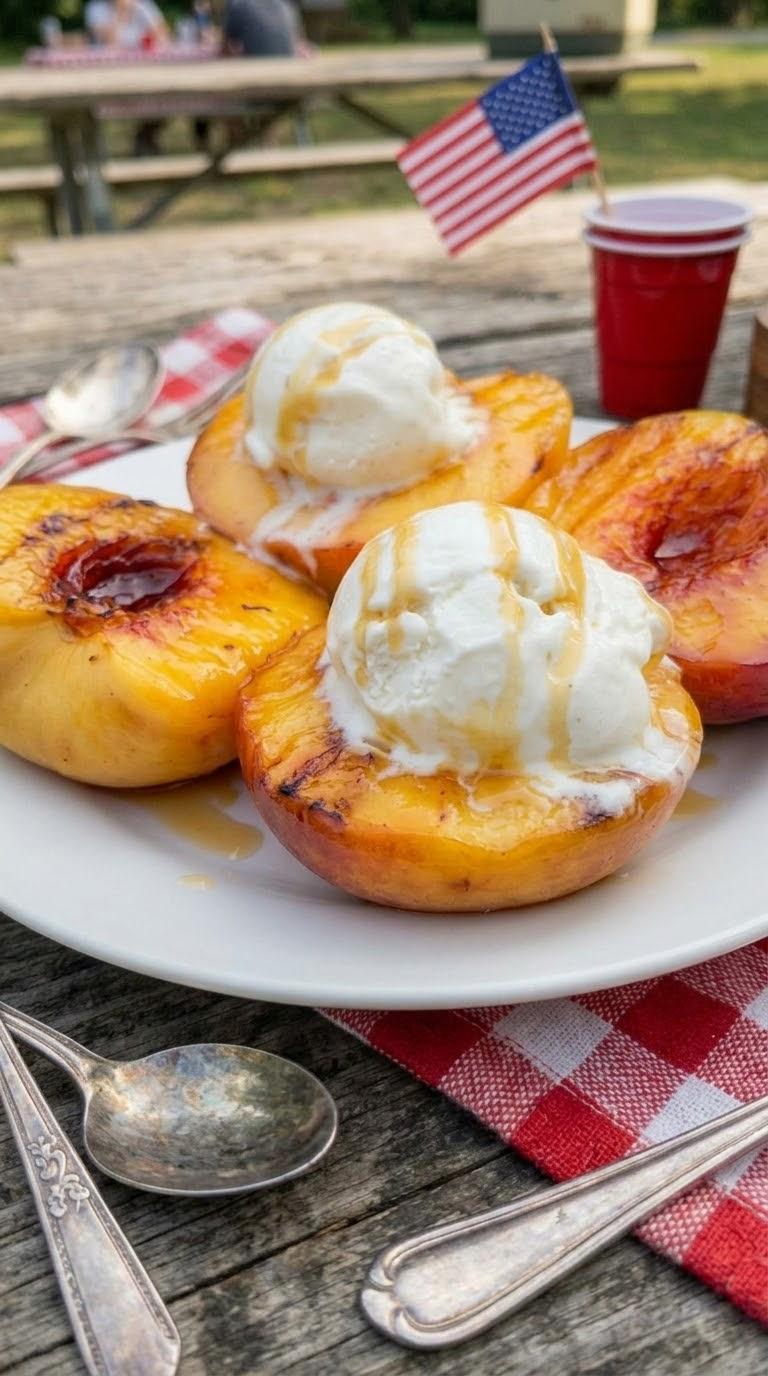
Betty Ford’s 3-Ingredient Caramel Peaches
Betty Ford’s Caramel Peaches date back to 1974 and reflect the kind of straightforward, all-American food associated with the Ford family.
And when I say simple, I mean it.
Peaches. Brown sugar. Butter.
That’s basically it.
The peaches cook until they’re warm and syrupy. Add vanilla ice cream and a drizzle of caramel, and you’ve got an easy dessert that still feels special.
It also happens to be exactly the kind of easy Labor Day dessert I love. There’s very little work involved, it takes advantage of beautiful peaches, and when you put the warm fruit together with melting vanilla ice cream, it looks like you spent considerably more time on dessert than you actually did.
Ingredients
- 8 firm peaches
- 8 tablespoons brown sugar
- 4 tablespoons butter
- Optional: vanilla ice cream
Directions
1. Peel the peaches, cut them in half and remove the pits.
2. Place the peach halves hollow-side up in a large frying pan. Add 1 tablespoon brown sugar and ½ tablespoon butter to the hollow of each peach.
3. Cook over low heat, carefully turning the peaches once, until the juices become thick and syrupy.
4. Serve warm, with vanilla ice cream if desired.
Shannon’s Tip
Serve these warm with vanilla ice cream and a drizzle of caramel sauce. It’s such an easy dessert, but it looks like you did a whole lot more work than you actually did.
Three ingredients. One pan. Ice cream on top. Done. That’s my kind of Labor Day dessert.
From Presidential Favorites to the American Potluck Table
The more I dug into these old recipes, the more I realized how much American food history looks like the food we still make when people come over.
Barbecue. Corn. Macaroni and cheese. Peaches. Cakes. Picnic food. Recipes that stretch far enough to feed everybody.
And that’s what inspired this Shannon’s in the Kitchen Labor Day Collection celebrating America’s 250th.
Along with these White House favorites, I’ve been pulling together the kinds of vintage Labor Day recipes, easy barbecue recipes and old-fashioned potluck dishes that still deserve a place on the table.
There’s Amish potato salad, calico beans, dill pickle dip, corn on the cob, orange fluff, Scotcheroos and plenty of other recipes that feel familiar for a reason.
Some are vintage recipes. Some are family favorites. Some are easy shortcuts. And some are simply recipes I think are too good to lose.
From My Family Table to Yours
Labor Day didn’t necessarily mean a day off when I was growing up. We were a farm family, and the calendar didn’t get to decide when the work was done.
But I remember the times when we did get a break. Maybe the sun was setting a little earlier. Maybe Dad got rained out of the field. Sometimes we’d pile into the car for a family fishing trip.
And somehow, most of the memories I still hold onto ended up around a table.
That’s probably part of why these recipes mean something to me. Food has a funny way of becoming part of the memory without you realizing it at the time. Years later, you remember who made the potato salad, what was always on the picnic table, or the dessert you hoped somebody would bring.
That’s what I wanted this collection to feel like.
Not complicated. Not fancy. Just good recipes worth making, sharing and maybe even remembering.
So wherever Labor Day finds you this year, I hope you get a little time with people you love — and something really good on the table.
Good food. Good friends. Long weekends.
Love,
Shannon
Join the party for exclusive giveaways and never miss out on any of the fun. Share your email and join the family!